Showing posts with label Mexico. Show all posts

Las Pozas, Xilitla, San Luis Potosí, Mexico

Sculptures in Las Pozas, Xilitla, San Luis Potosí, Mexico.
The following information is from Wiki

Las Pozas is near the village of Xilitla, San Luis Potosí. The natural beauty of Xilitla inspired eccentric English artist Edward James to create Las Pozas (the Pools), a garden in a subtropical rainforest just outside the town of Xilitla.

Sculptures in Las Pozas, Xilitla, San Luis Potosí, Mexico.
It includes more than 80 acres (32 ha) of natural waterfalls and pools interspersed with towering surrealist sculptures in concrete. James' objective was to create a "Garden of Eden" at Las Pozas.

Waterfalls in Las Pozas, Xilitla, San Luis Potosí, Mexico.
Between 1949 and 1984, James built scores of surreal concrete structures with names like The House on Three Floors Which Will in Fact Have Five or Four or Six, The House with a Roof like a Whale, and The Staircase to Heaven.
Sculptures in Las Pozas, Xilitla, San Luis Potosí, Mexico.
There were also plantings and beds full of tropical plants, including orchids — there were, apparently, 29,000 at Las Pozas at one time — and a variety of small casas (homes), niches, and pens that held exotic birds and wild animals from the world over—James owned many exotic animals.
Sculptures in Las Pozas, Xilitla, San Luis Potosí, Mexico.
Massive sculptures up to four stories tall punctuate the site. The many trails throughout the garden site are composed of steps, ramps, bridges and narrow, winding walkways that traverse the valley walls. Construction of Las Pozas cost more than $5 million.

The above pictures were taken by Gary, KGH

You might be interested in the following web : Mountain Hiking behind Laguna Mojanda Otavalo, Ecuador
You might be interested in the following web : Snorkeling in Long Beach Ko Lanta, Thailand

Conservación de Tortugas Marinas Riviera Maya, Tulum Mexico


Xcacel beach, near Akumal / Tulum , Mexico. A protected and [almost] deserted beach, use red torches at night if seeing turtles very important. Costs a dollar or something admission to beach, you get a ticket, it goes towards the turtles. special place.


Information Source : Wikimapia

Holbox, Quintana Roo, Mexico

(Picture taken by Gary, KGH)

Holbox is an island in the Mexican state of Quintana Roo, located on the north coast of the Yucatán Peninsula. It is approximately 41.84 kilometers long and 1.5 kilometers wide, and it is separated from the mainland by a shallow lagoon that is home to flamingos, pelicans and other rich birdlife. Holbox Island is part of the Yum-Balam Biosphere Reserve.

(Picture taken by Gary, KGH).

Holbox has several alternatives to enjoy nature, but the one that attracts most visitors is the experience of swimming with the impressive whale shark from June to September, an opportunity you can experience in very few parts of the world.

Information source : Wiki

Chichen-itza, Yucatan, Mexico


Chichén Itzá is the largest of the archaeological cities of the pre-Columbian Maya civilization in the Yucatan Peninsula of Mexico. It is one of Mexico's most visited tourist destinations. It was granted World Heritage Site status in 1988 by UNESCO World Heritage Site and was recently selected as one of the New Seven Wonders of the World. (Picture taken by Gary, KGH).

Information Source : Wikitravel

Guanajuato Underground Roadways, Mexico

Juarez Street is one of the few through streets on the surface. It is filled with various stores and restaurants and has a constant flow of both people and traffic.


The other through streets of town are either partially or fully underground, following the old drainage ditches and tunnels dug during colonial times. Originally they were used for flood control, but modern dams have controlled flooding and left them dry, so they have been turned into thoroughfares in a city with little surface area.


The most important of these roads is Miguel Hidalgo or Belaunzarán, which carried the runoff from the river that used to divide the city in two. Guanajuato’s version of the La Llorona story has the woman wandering the tunnels of the city, some of which had rivers or streams running through them.


Information Source : Wiki

The other interesting photos : Lake Chapala Malecón, Mexico
The other interesting photos : How to make Tortilla, San Pedro La Laguna, Guatemala

El Escondido Hot Spring, San Miguel de Allende, Mexico

Located just outside the romantic city of San Miguel de Allende. Unlike other hot springs areas this is trully a paradise.


Here you can ease your tensions and soothe tired muscles by relaxing in one of Escondido Place’s pools of steaming, mineral-rich waters along the road to Atotonilco.


The landscape is traditional; with picnic areas and snack bars, family-friendly; where kids enjoy play areas, and you can enjoy spa services and full restaurants.


Escondido has amazing gardens and ten pools with water temperature up to 104F. Escondido has both indoors pool and outdoor pools where you can relax under the open sky or sheltered by rock-lined grottos.

Information Source : Visit San Miguel

The other interesting photos : Lake Chapala,Mexico
The other interesting photos : San Pedro la Laguna, Guatemala

Mirador, San Miguel de Allende, Mexico

The Mirador is a lookout point which offers the best view of the San Miguel de Allende. It is on the southeast side of town. You can get here on foot. The sightseeing trolleys that depart several times a day from the Jardín stop by here.


There is a handicrafts market and a cafe here, so you can have some refreshment while you enjoy the wonderful view.


Imformation source : Gomexico

The other interesting photos : Instituto Cultural Cabañas, Guadalajara, Mexico
The other interesting photos : Panajachel, Lago de Atitlán, Guatemala

El Chorro, San Miguel de Allende, Mexico

The oldest part of San Miguel de Allende is the El Chorro neighborhood. This is where the village of San Miguel was moved to in 1555. The Nahuatl name for the area was Izcuinapan or “place of dogs,” and according to legend, dogs led Juan de San Miguel to this area to find this spring.


This area is the home of the Parish of San Miguel, the Jardin Principal or Main Garden and an earlier church called the San Rafael or Santa Escuela Church


Information Source : Wiki

The other interesting photos : Plaza de la Liberacion, Guadalajara, Mexico
The other interesting photos : Learn Spanish in Xela, Guatemala

Las Monjas Church ( Templo de la Inmaculada Concepcion ) , San Miguelde Allende, Mexico


In San Miguelde Allende, Next to the cultural center is the Inmaculada Concepcion Church, locally known as Las Monjas (The Nuns). It was originally constructed as part of the convent. The church was constructed between 1755 and 1842 with an elegant cupola added by Zeferino Gutierrez in 1891, inspired by the Les Invalides Church in Paris.


The cupola is octagonal decorated with Corinthian columns in the lower area and the upper area has a window with a balustrade and statues of saints. Topping the cupola is a lantern window with a statue depicting the Immaculate Conception. Inside, there are paintings by Juan Rodriguez Juarez.


Information Source : Wiki

The other interesting photos : TUR Bus, Guadalajara, Mexico
The other interesting photos : Taking bus to Quetzaltenango, Guatemala.

Aqueduct in Santiago de Querétaro, Mexico

The most prominent feature of the city is its enormous aqueduct, consisting of seventy five arches, each twenty meters wide with a total extension of 1,280 meters and an average height of twenty three meters.


It was built by the Marquis Juan Antonio de la Urrutia y Arana between 1726 and 1738 at the request of the nuns of the Santa Clara Convent to bring water to the residents of the city from La Cañada.

Information Source : Wiki

The other interesting photos : La Plaza de Armas, Querétaro, Mexico
The other interesting photos : Huaraches, León, Mexico

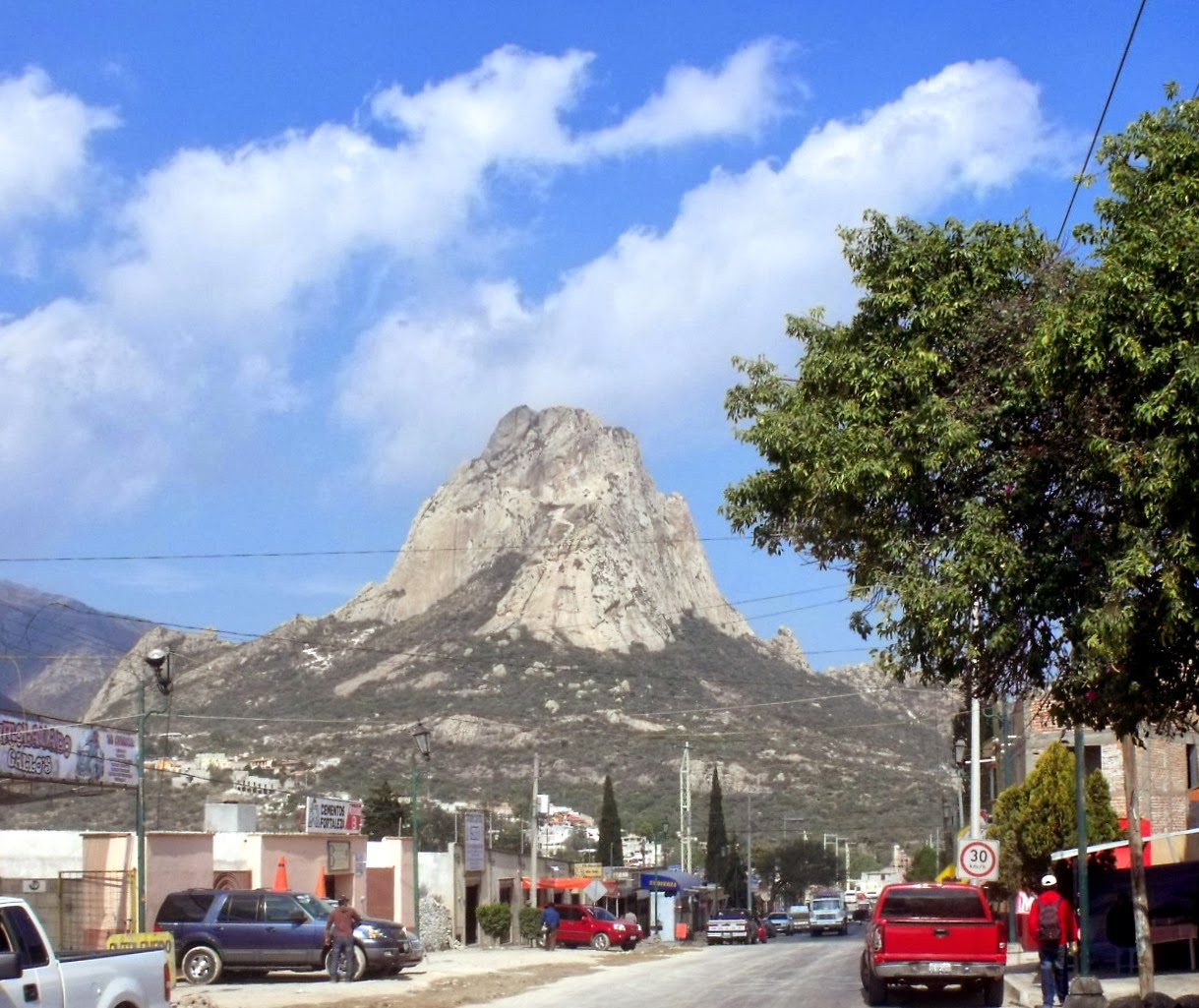
Peña de Bernal, Querétaro, Mexico

Peña de Bernal (in English: Bernal's Boulder or Bernal Peak) At 433 m (1,421 ft) it is one of the tallest monoliths in the world. Other tall monoliths include the Rock of Gibraltar and Sugarloaf Mountain. (Mount Augustus, in Western Australia, is sometimes credited to be the world's second largest monolith.


Peña de Bernal is located in San Sebastián Bernal, a small town in the Mexican state of Querétaro.


According to Leonor López Domínguez of México Desconocido, the porphyrytic monolith was formed some 100 million years ago during the Jurassic period, when it must have been at least three times higher than today.


A recent chemical analysis by researchers at the National Autonomous University of Mexico has determined that it is much younger—likely formed about 8.7 million years ago.


Many people make a pilgrimage to the highest point hikeable, visiting a little chapel about halfway up.

Information Source : Wiki

The other interesting photos : Sanctuary of Atotonilco, San Miguel de Allende, Mexico
The other interesting photos : San Miguel de Allende, Mexico

Church of the Immaculate Conception, San Miguel de Allende, Mexico

The convent of this church, known as Las Monjas, was founded by Josefa Lina de la Canal y Hervas (1736-1770), the first-born of Manuel Tomas de la Canal (1701-1749).


From the very first day of the convent’s foundation to the inauguration of the actual structure, Maria Josefa de la Canal worked arduously to sustain the project that she herself created—both in terms of financing and religious pursuits. Maria Josefa passed away five years after the official opening, on August 9, 1770.


Initiated in 1755, the new convent took ten years to build, and upon completion, the nuns moved into their new home to commemorate the occasion on December 28, 1765. The church, however, remained unfinished, including the main towers, the bell tower and altars, which were completed during the first half of the 19th century.


Another important component that remained missing was the dome, and talented mason Zeferino Gutiérrez (also author of the Parroquia’s neo-Gothic façade) was called on to do the job. Assisted by the great Mexican artist popularly known as Dr. Atl, Gutiérrez found inspiration in the monumental church of Les Invalides in Paris.

Information source : Visit San Miguel

The other interesting photos : The beautiful church in Guanajuato, Mexico
The other interesting photos : Templo Expiatorio, Guadalajara, Mexico

Caesar’s Salad, Tijuana, Baja California, Mexico


Cesare Cardini (February 24, 1896 – November 3, 1956) was an Italian American restaurateur, chef, and hotel owner, who is credited with creating the Caesar salad.


After having worked in European gastronomy, Caesar went to the United States in his early 20s. He ran a restaurant in Sacramento, then he moved to San Diego where he was in the restaurant business. At the same time he engaged in the same business in Tijuana, where he could avoid the restrictions of prohibition.

Cardini is credited with having created "Caesar's salad" which became fashionable among Hollywood and other celebrities, especially after he had moved his restaurant a few blocks to the hotel built c. 1929 (nowadays called Hotel Caesar's).

Information Source : Wiki

The other interesting photos :Sanctuary of Atotonilco, San Miguel de Allende, Mexico
The other interesting photos : Children in Angahuan Michoacan Mexico.
The other interesting photos : Church on top of the Maya Pyramid, Cholula, Puebla, Mexico

Parque Benito Juarez, San Miguel de Allende, Mexico


The park grounds were once full of plentiful orchards and vegetable plots thanks to the water coming down from El Chorro. Dr. Hernández Macías wanted San Miguel residents to have a place for recreation, and also wanted to create a "lung" for the city, and so over a period of 9 years, from 1895 to 1904, he bought the orchards one by one and put them together to create this park, an extraodinarily beautiful sight when it opened 100 years ago.


Specially chosen trees grew lush, pruned cedars and acacias graced the two original entrances on Diez de Sollano and Aldama (fomerly Calle de Hospital), lawns were dotted with calla lilies, and sculpted hedges lined the interior paths. The park also had two large cisterns, which would supply water in case El Chorro ran dry.


Where today we see basketball courts was once a field full of sunflowers, with an impressive fountain in the middle. Though that fountain is gone, other fountains have been preserved. These all have low walls, letting us see reflections on the water.

Information Source : Welcome Sanmiguel

The other interesting photos : Chichen-itza, Yucatan, Mexico
The other interesting photos : Panajachel, Guatemala

Cathedral and Plaza de Armas, Morelia, Michoacán, Mexico


One of the Morelia downtown highlights is the baroque cathedral with its surrounding plazas: the Plaza de Armas. The cathedral is enormous, covering more than 2 city blocks in area. Architectural details like the flying buttresses and tiled cupolas give it a distinctive look.


The Cathederal is the site for the local “Day of the Dead” celebration in early November. It is more of an experience than can be described here. Most of the activities take place after dark and especially on the weekend.

Information Source : Wikitravel

The other interesting photos : El Acueducto (The Aqueduct) , Morelia, Michoacán, Mexico
The other interesting photos : Santuario de Atotonilco, San Miguel de Allende, Mexico

Volcán de Parícutin, Michoacán, Mexico

Volcán de Parícutin is a cinder cone volcano in the Mexican state of Michoacán, close to a lava-covered village of the same name. The volcano is unique in the fact that its evolution from creation to extinction was witnessed, observed and studied. It appears on many versions of the Seven Natural Wonders of the World.


San Juan Parangaricutiro Church

Volcán de Parícutin erupted and the lava buried 2 villages. Finally the lave reached and flew over the graves around San Juan Parangaricutiro Church. But leaving the church tower and altar untouched.


Information source : Wiki

The other interesting photos : Chichen-itza, Yucatan, Mexico

Veracruz, Mexico

(Picture taken by Gary, KGH).

Veracruz, officially known as Heroica Veracruz, is a major port city and municipality on the Gulf of Mexico in the Mexican state of Veracruz. The city is located in the central part of the state, 90 km (56 mi) from the state capital Xalapa.

Veracruz is Mexico’s oldest, largest, and historically most significant port since European colonization.

Information Source : Wiki

The other interesting photos : Puebla, Mexico
The other interesting photos : Plaza de la Constitución, Querétaro, Mexico


Tijuana, Baja California, Mexico


Tijuana is the largest city on the Baja California Peninsula. An industrial and financial center of Mexico. As the city has become a leading center in the country, so has the surrounding metropolitan area, a major industrial and paramount metropolis in northwestern Mexico. Currently one of the fastest growing metropolitan areas in Mexico.

The city is the most visited border city in the globe; sharing an approximate 24-kilometre-long border (15 mi) with its sister city San Diego, over fifty million people annually cross the border between these two cities.

This metropolitan crossing makes the San Ysidro Port of Entry the busiest land-border crossing in the world. It is estimated that the two border crossing stations between the cities proper of San Diego and Tijuana account for 300,000 daily border crossings alone.

Information source : Wiki

Campeche, Mexico

Comitán, Chiapas, Mexico


Comitán is the fourth-largest city in the Mexican state of Chiapas. It is located in the east-central part of Chiapas, near the border with Guatemala . The population is around 90,000 people.

Comitán is also a popular tourist destination, mostly for Mexican nationals, though some foreign visitors can also be seen. The town itself is one of the most pleasant and pretty in Mexico, with colonial architecture, narrow avenues, and clean streets.


The climate is cool most of the year, and can get quite chilly from October to March. The town square is active almost every night, with live music, or some kind of presentation.

Information Source : Wiki

The beautiful church and park in Morelia, Michoacán, Mexico

Celestún, Yucatan, Mexico


Parque Natural del Flamenco Mexicano (also known as the "Celestun Biosphere Reserve") is a wetland reserve that is the winter home to vast flocks of flamingos, as well as many herons and other bird species. This location is set within the Petenes mangroves ecoregion. In addition, more than 200 species of birds pass through on migration, or live there.

Information Source : Wiki Travel

MBT Mexico Sky (Chinese Traditional)